Measure three dimensions
How to Calculate a Pipe Trench
Measure the route
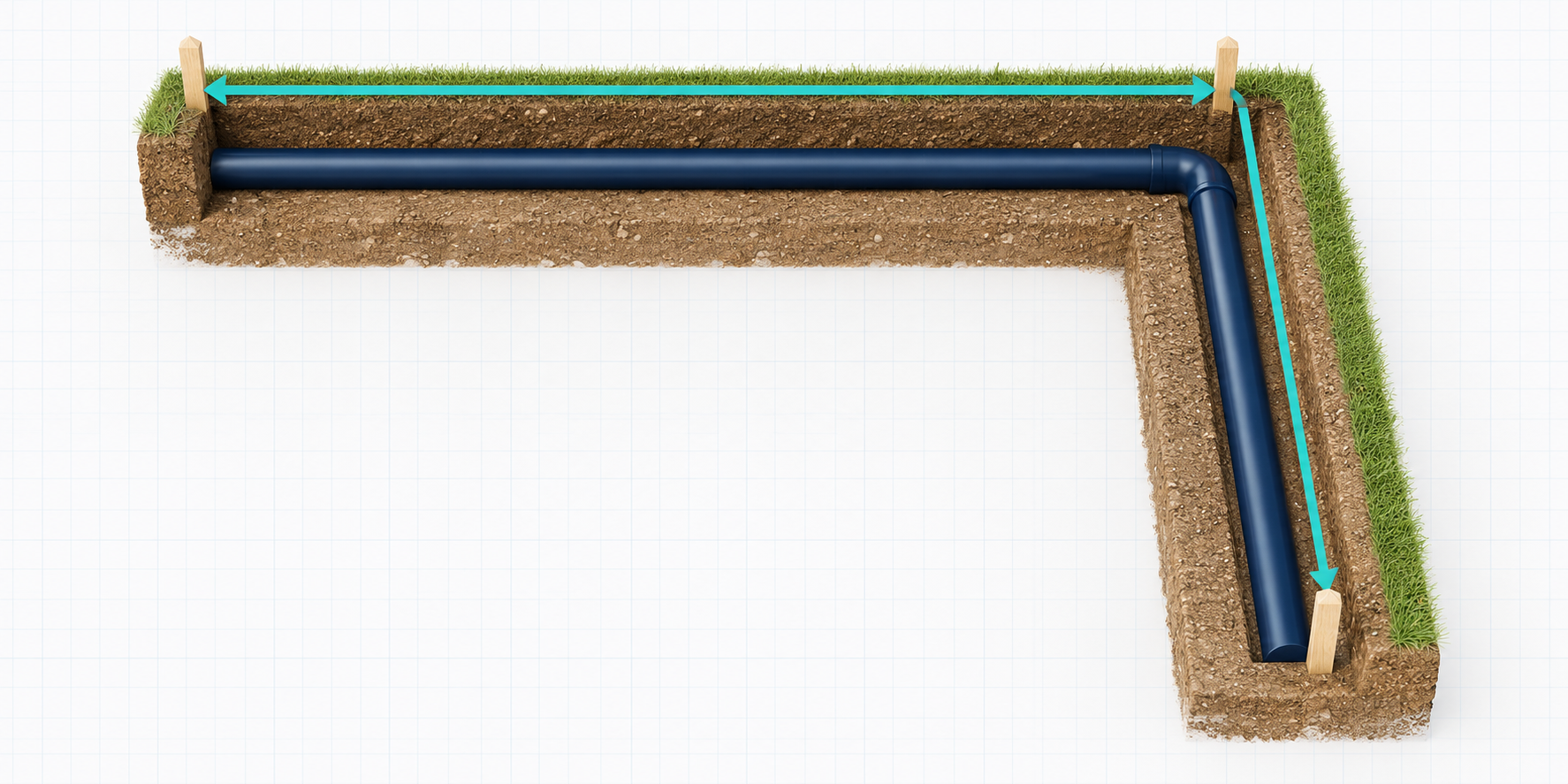
Route length is the excavation path from one end of the trench to the other. Add every straight leg, bend, and offset; do not replace an L-shaped route with a diagonal line between its endpoints.
Confirm width and depth
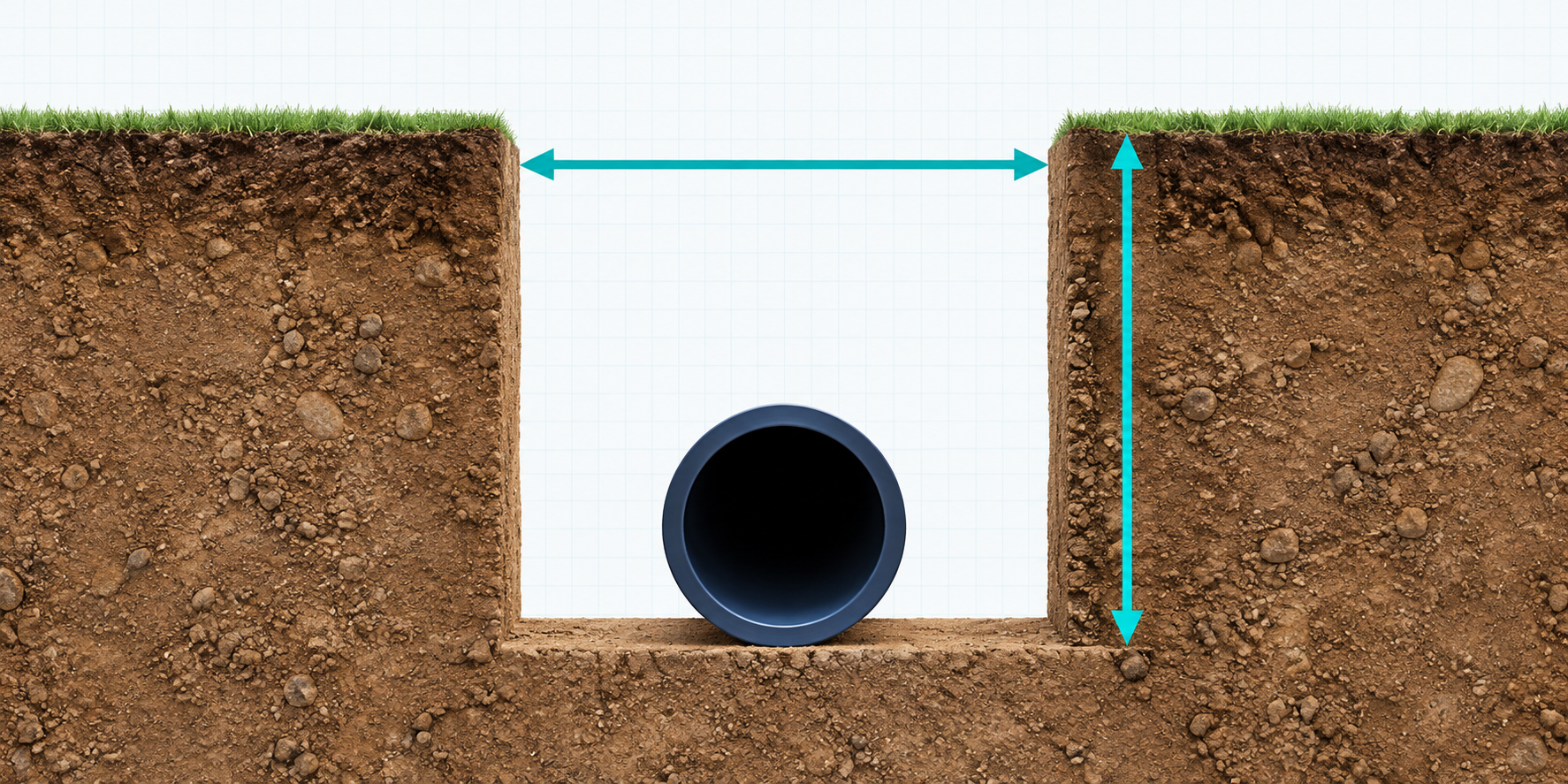
Trench width is the planned horizontal distance between the sidewalls. Trench depth is the vertical distance from finished grade to the trench bottom. Enter the dimensions shown on your drawing or site notes; this calculator does not choose them.
Check the volume
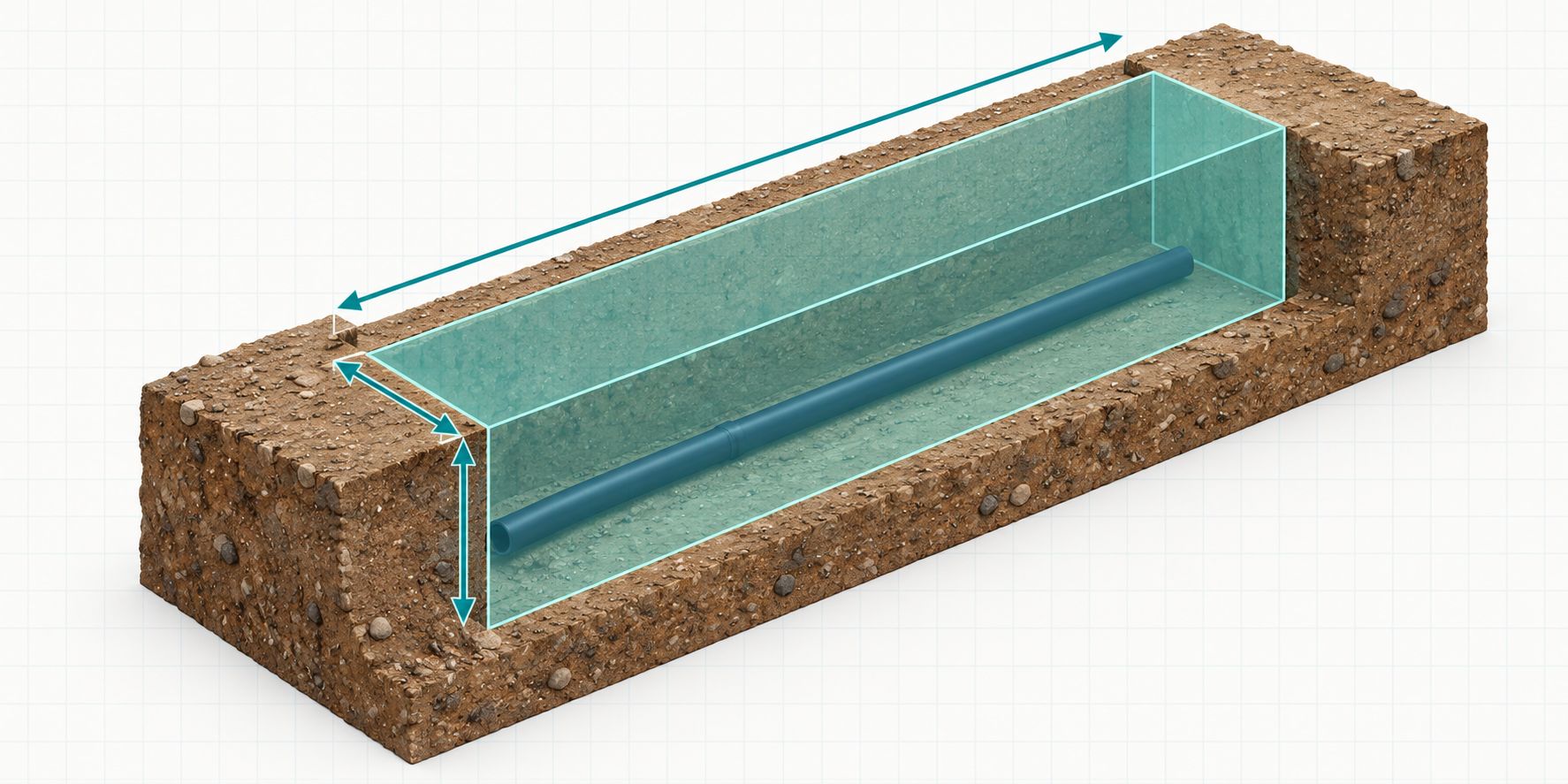
First, length × width gives the trench footprint. Then, multiply that footprint by depth to get the excavation volume. The calculator shows the result in cubic feet, cubic yards, and cubic metres.
Worked example
30-Foot Pipe Trench Volume Example
Suppose the planned pipe trench follows a 30-foot route and uses a uniform 2-foot width and 4-foot depth. With those three dimensions, the rectangular formula gives:
- 01
Find the footprint: 30 ft × 2 ft = 60 ft².
- 02
Find the excavation volume: 60 ft² × 4 ft = 240 ft³.
- 03
Convert the result: 240 ft³ ÷ 27 = 8.89 yd³, or 6.80 m³.
When a route changes dimensions: Calculate each uniform section, then add the volumes. For example, a 20 ft × 2 ft × 4 ft section is 160 ft³ and a 10 ft × 3 ft × 4 ft section is 120 ft³. Together, the excavation volume is 280 ft³, or 10.37 yd³.
Scope and limits
What This Calculator Calculates and What It Does Not
Enter the planned trench route length, width, and depth, and this calculator multiplies those three dimensions to find the volume of a straight-sided rectangular excavation. It treats the values you enter as one uniform trench.
This is a geometry check, not a trench-design, material, or safety tool. Use the project drawings and site requirements to choose the trench dimensions and address pipe size and slope, required cover, soil conditions, utility locations, sloping or shoring, bedding, backfill, haul-off, and any adjustment for loose soil, compaction, or pipe displacement.
Need to choose a water pipe? Start with the Pipe Size Calculator. Planning a gravity drain? Use the Drain Pipe Slope Calculator for the required fall.
Quick answers
Pipe Trench Volume Calculator FAQs
What length should I enter?
Enter the planned route length along the trench. Include bends and offsets instead of measuring a straight line between the first and last point.
Does this calculator choose the trench depth?
No. Enter the planned depth from the job drawings or project requirements. The result only converts those dimensions into volume.
Why does the result use cubic yards and cubic metres?
Excavation volume is commonly discussed in cubic yards or cubic metres. The calculator also shows cubic feet for a quick dimensional check.
Can I use it for a sloped drain trench?
Yes, when the trench width stays constant and the depth changes evenly along the route: enter the average planned depth. If the width varies or the depth changes irregularly, calculate separate segments and add their volumes. For the pipe fall itself, use the Drain Pipe Slope Calculator separately.
Does this include the pipe, bedding, or backfill?
No. It calculates the full rectangular excavation space only. It does not subtract pipe displacement or calculate bedding or backfill quantities.