Use the right load
How This Gas Line Sizing Calculator Works
Add downstream demand
Use the maximum input rating from every appliance supplied by the pipe segment, assuming simultaneous operation.
Choose the longest row
Enter the longest design length from the point of delivery to the most remote outlet. The calculator rounds up to the next table row.
Select adequate capacity
The first pipe size whose table capacity meets or exceeds the calculated cubic-feet-per-hour demand is returned.
Worked example
Size a 100,000 Btu/h Gas-Pipe Segment
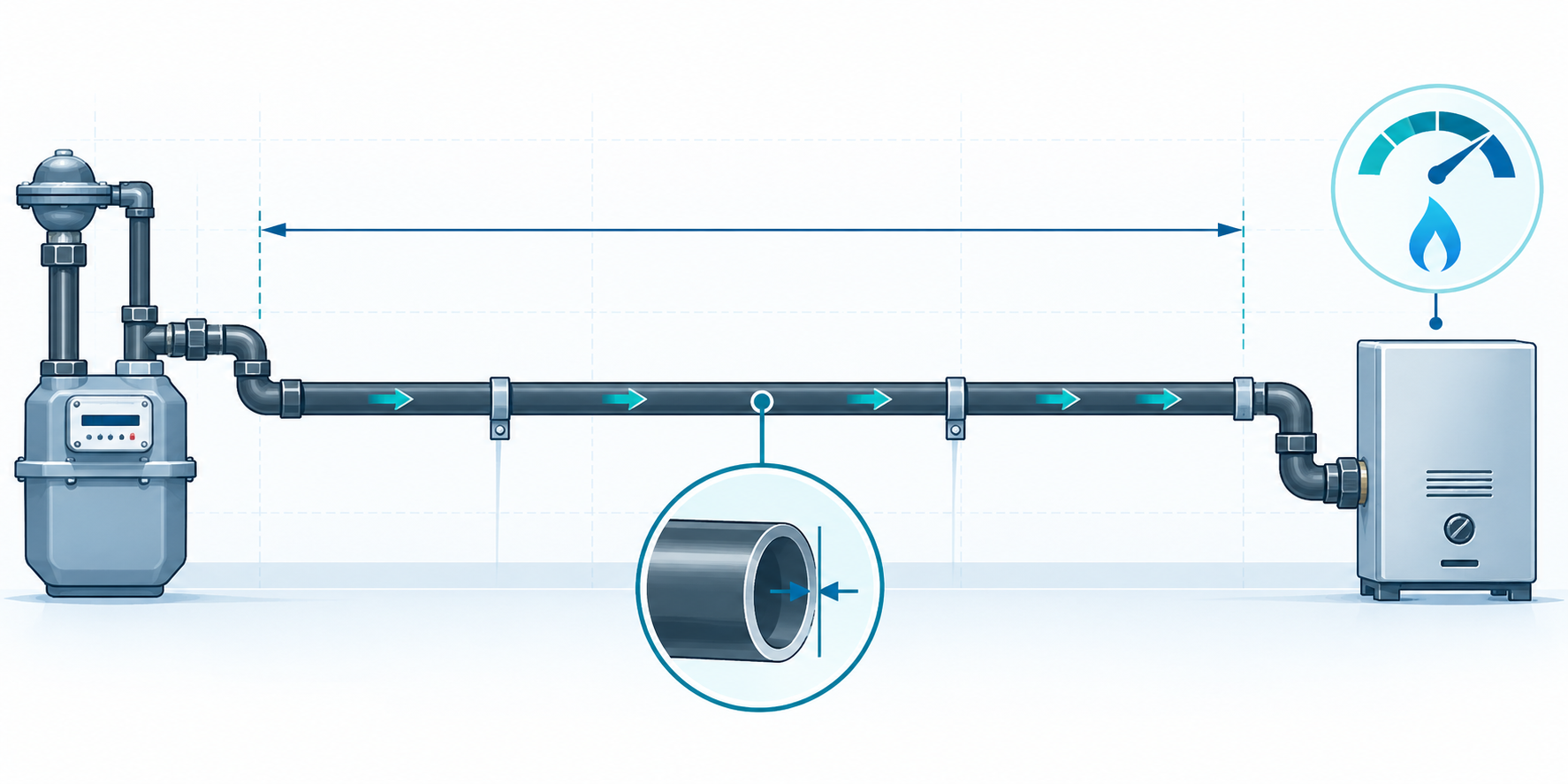
Suppose a pipe segment supplies 100,000 Btu/h of connected appliance input. The longest design length from the point of delivery to the most remote outlet is 50 feet, and the available natural-gas heating value is 1,000 Btu/ft³.
- 01
Find gas demand: 100,000 Btu/h ÷ 1,000 Btu/ft³ = 100 CFH.
- 02
Use the 50-foot row: The longest design length matches the 50-foot table row, so that row is used for this segment.
- 03
Choose the first adequate size: At 50 feet, ½ in. pipe is listed at 72 CFH and is too small. The next size, ¾ in., is listed at 151 CFH, so the table-based minimum is ¾ in.
This is an example of the calculator’s table-based result, not an installation design. Confirm the actual appliance inputs, delivery conditions, adopted code, and pipe material before work begins.
For a full system
How to Size Multiple Gas-Pipe Segments
With the longest-length method, first find one design length from the meter or other point of delivery to the most remote outlet. Use that equal or next-longer table row when checking every Schedule 40 metallic-pipe segment in the system.
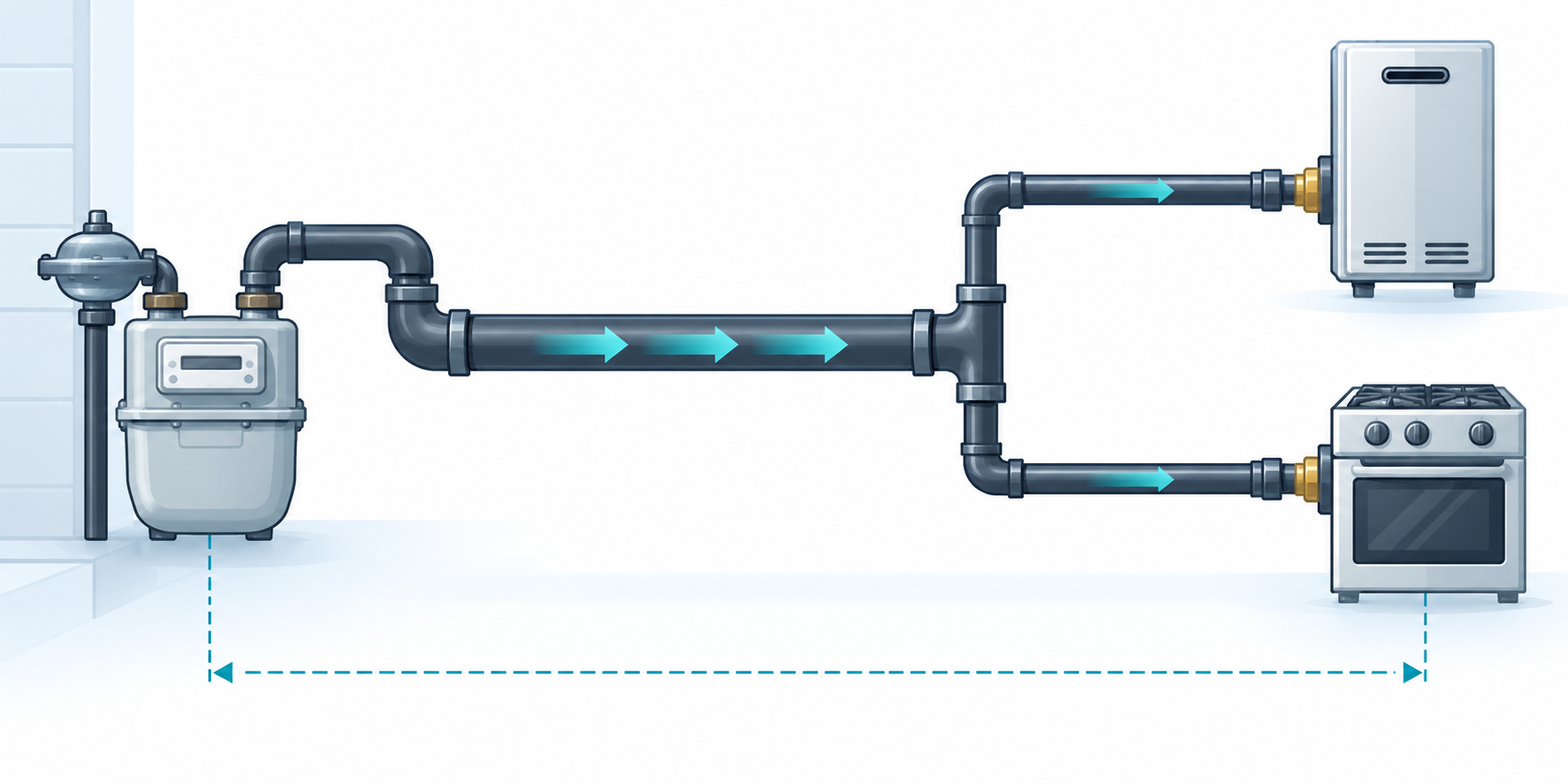
Then calculate each segment’s own downstream demand. A main that supplies several appliances carries the combined load of all of them. A branch carries only the load of the appliances beyond that branch. Enter each known segment load separately in this calculator to check its table-based minimum size.
This calculator does not draw a piping diagram or decide which appliances are downstream of each segment. Use the plans and actual pipe layout to identify those loads before calculating.
Scope and limits
What This Calculator Does and Does Not Size
This calculator handles one natural-gas Schedule 40 metallic-pipe segment using the longest-length method and table rows from 10 through 350 feet. It does not size propane, CSST, copper, polyethylene, higher-pressure systems, gas meters, regulators, combustion air, venting, appliance connectors, branches from a piping diagram, or pipe installation details.
For every gas-pipe project, confirm the current locally adopted code and the gas utility’s delivery conditions. The ICC fuel-gas pipe sizing notes explain the longest-length method and its table selection process.
Quick answers
Gas Line Sizing FAQs
What length should I enter?
Enter the longest design length from the meter or other point of delivery to the most remote outlet in the system, including any applicable equivalent length for fittings. This same table row is used when sizing each section by the longest-length method.
How do I find the appliance load?
Use each appliance’s maximum input rating from its nameplate or manufacturer literature. Add the loads of every appliance that the pipe segment supplies; do not use an appliance’s output rating.
How do I size a main and a branch?
Use the same longest-length table row for both, then enter the downstream load carried by each segment. The main carries the combined demand of the appliances it supplies; a branch carries only the demand beyond that branch.
Does the existing-pipe check confirm my installation?
No. It compares the selected nominal size with this calculator’s listed capacity at the chosen table row. Confirm pipe material, actual route length, fittings, fuel conditions, code requirements, and the installed system separately.
Can I use this for propane or CSST?
No. Propane, CSST, copper tubing, polyethylene, and other materials or pressure conditions use different capacity tables. Use the table specified for the actual fuel, material, pressure, and local code.
Why does the calculator round the length up?
The longest-length method uses the table row equal to the measured length or the next longer row when there is no exact match. This is more conservative than rounding down.